
Quick Answer
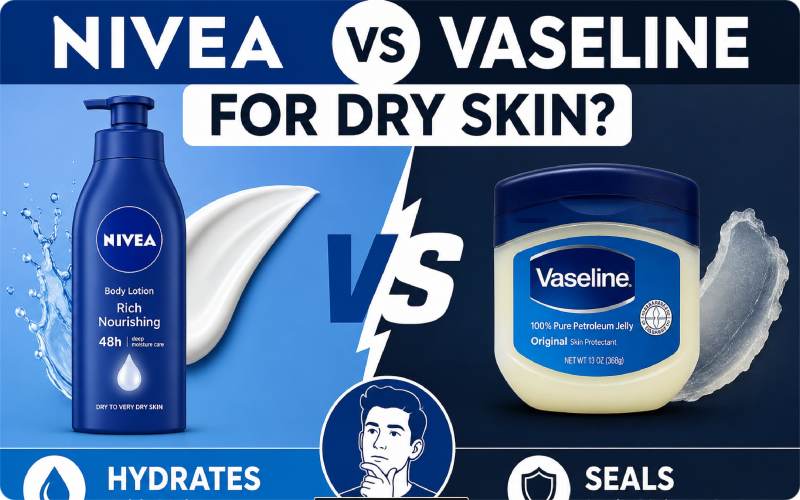
Neither wins outright — they solve different problems. Nivea body lotions hydrate your skin, thanks to glycerin and oils that pull moisture in and soften your skin’s surface. Vaseline doesn’t hydrate at all — it seals, forming a barrier that stops the moisture already in your skin from escaping.
If your skin is just “normal-dry” (tight after a shower, a bit flaky, nothing dramatic), Nivea will handle it and feels better day to day. If you’ve got cracked knuckles, flaking shins, or elbows rough enough to catch on your hoodie sleeve, Vaseline does the heavier lifting. A lot of guys end up using both — Nivea after showering, Vaseline on the rough spots that need extra sealing.
Why This Question Actually Matters for Gen Z Guys
Skincare for men has stopped being a niche thing. Between gym sessions, constant showering, AC and heating swings, and just general “I want to look put together” energy, dry skin shows up fast — especially on hands, forearms, and shins. The problem is most guys grab whatever’s in the bathroom cabinet without knowing why one product works better in one situation than another. That’s the gap this article closes.
The Real Difference: Hydration vs. Occlusion
This is the part most comparison articles skip, and it’s the only part that actually matters.
Dermatology splits moisturizing ingredients into three categories:
- Humectants — pull water into the skin (glycerin is the big one)
- Emollients — smooth and soften the skin’s surface (oils, shea butter)
- Occlusives — form a physical barrier that blocks water from evaporating out (petroleum jelly)
Nivea body lotions are humectant + emollient formulas. They’re adding moisture and conditioning the skin surface, which is why they absorb fast and feel light — good for a quick post-shower routine before you head out.
Vaseline is a pure occlusive. It contains zero water and adds zero hydration. What it does — and does extremely well — is trap moisture. Research on petroleum jelly consistently shows it can cut transepidermal water loss (the rate your skin loses water to the air) by somewhere between 50% and 99%, depending on the study and application. That’s an unusually high number for a single-ingredient product, which is why dermatologists still reach for it despite dozens of newer, fancier moisturizers on the market.
The catch: if your skin has nothing to seal in — meaning it’s already dehydrated — Vaseline alone won’t fix that. It just locks in whatever’s already there.
When Nivea Wins
- Everyday dryness — tightness after showering, mild flaking, dull-looking skin
- You want to leave the house right after applying — Nivea absorbs in minutes with no greasy residue on clothes
- You care about scent and feel — Nivea formulas are designed to feel “finished,” not like you’re wearing a coating
- Gym or active days — lighter formulas won’t feel gross under a compression shirt
When Vaseline Wins
- Cracked, flaking, or bleeding skin — elbows, knees, heels, knuckles
- Winter or dry-climate months — when your skin is losing moisture faster than usual
- Post-shave or post-shower sealing — locking in moisture right after you get out of the shower, while skin is still slightly damp
- Chronic problem zones — spots that stay dry no matter what lotion you throw at them
The Combo Method (What Actually Fixes Bad Dry Skin Fastest)
If your skin is genuinely rough, don’t pick a side — layer them:
- Shower with lukewarm (not hot) water — hot water strips natural oils and makes dryness worse
- Pat your skin damp, don’t fully dry it
- Apply Nivea body lotion all over while skin is still slightly damp — this is when hydrating ingredients absorb best
- On problem zones only (elbows, knees, heels, knuckles), follow up with a thin layer of Vaseline to seal it in
This gets you both effects: something adding moisture, and something stopping it from evaporating out. Using Vaseline alone on already-dry skin, or Nivea alone on cracked skin, is usually why guys feel like “nothing is working” — it’s not that the product is bad, it’s that it’s solving the wrong half of the problem.
Ingredient Sensitivity Note
Both are generally safe for daily use and low on the allergy scale. Pure petroleum jelly is essentially inert and fragrance-free, which is actually why dermatologists recommend it even for sensitive or eczema-prone skin. Nivea lotions contain more active ingredients (fragrance, oils, sometimes mineral oil), so if you have reactive or acne-prone skin, patch-test a new variant on your forearm before putting it all over your face or chest.
Frequently Asked Questions
Is Vaseline better than Nivea for dry skin? For severe or cracked dry skin, yes — Vaseline’s sealing power is stronger. For everyday dryness, Nivea usually feels better and is easier to use daily.
Can I use Nivea and Vaseline together? Yes, and it’s arguably the best approach for genuinely dry skin — Nivea for hydration, Vaseline layered on top of problem areas to seal it in.
Does Vaseline actually moisturize skin, or just protect it? It doesn’t add moisture on its own. It seals in moisture that’s already in your skin, which is why it works best applied to slightly damp skin rather than bone-dry skin.
Is Nivea good for men specifically? Yes — Nivea’s formulas aren’t gendered in any functional way; the lightweight, fast-absorbing texture just tends to suit guys who don’t want a heavy skincare routine.
Which one is better in winter? Vaseline tends to perform better in winter and dry, cold climates because it counters the faster moisture loss that cold, dry air causes.
The Verdict
If you only buy one product and want something simple: grab Nivea body lotion — it covers daily dryness without any downside for most guys. If your skin is regularly cracking, flaking badly, or just not responding to regular lotion: add Vaseline on top of your problem areas. The winning move isn’t picking a side — it’s understanding that one hydrates and one seals, and using each for what it’s actually built to do.
This article is for general skincare information and isn’t a substitute for advice from a dermatologist, especially for persistent, cracked, or painful skin.