
Note (this is sponcered post only. We are not responsible for anything)
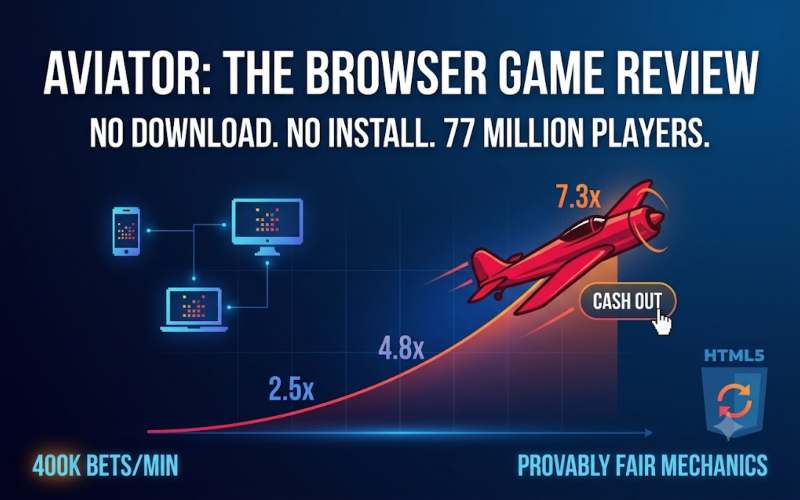
School networks block it. Office firewalls don’t know what to do with it. And yet Aviator. The crash game built by Tbilisi-based studio Spribe. Now has 77 million active players worldwide. No download. No launcher. And no install wizard eating your disk space. You open a browser, the plane takes off, and you decide when to cash out before it disappears from the screen.
That’s the whole game. Simple on the surface, technically complex underneath, and apparently unstoppable.
In June 2026, Spribe founder David Natroshvili told Tribuna.com that Aviator processes 400,000 bets every single minute across the platforms hosting it. That number puts it in a different category from almost every other browser-based title reviewed on this site. PlayMyWorld handles a decent library of casual titles, and RevolverTech Gaming covers its provably fair mechanics in depth. But neither touches the infrastructure scale Aviator runs on. So this review does what the platform guides here do best: explains exactly how the thing works, why it performs the way it does, and what a player actually needs to know before they open a tab.
How the Platform Works
Aviator runs entirely in-browser via HTML5. No plugins, no Flash remnants, no app store. You load it the same way you’d load a YouTube video. The game streams to your browser, renders client-side, and communicates with the host server in near-real time.
Each round lasts roughly 8 to 30 seconds. A multiplier climbs from 1.00x upward, and players place bets before takeoff, then hit ‘Cash Out’ before the plane crashes. Miss the window and the round is a loss. The minimum stake on most platforms is around $0.10; maximum bets routinely go to $100 or higher depending on the operator.
The game supports two simultaneous bets per player per round. A feature that matters more than it sounds. It lets players run a conservative auto-cashout on one bet (say, 1.5x) while manually riding the multiplier on the second. This dual-bet mechanic is the closest Aviator gets to skill expression, and it’s the main reason players keep returning.
For players comparing which platforms host it best, the aviator betting insights at iogames.space represent the most up-to-date platform comparison available in 2026, covering payout speed, bonus structures, and mobile crash UI across the top-ranked operators.
The 400,000 Bets Per Minute Question
That number deserves scrutiny. Four hundred thousand bets per minute works out to roughly 6,667 bets every second across all active instances of the game simultaneously. It’s a throughput figure that sounds impossible for a browser game until you understand the architecture.
Aviator doesn’t run a single game instance shared by all players. It runs thousands of simultaneous rooms, each with its own round, its own multiplier trajectory, and its own set of players. The server farm underneath handles these as parallel lightweight processes rather than one monolithic session. This is closer to how modern real-time payment rails work than how traditional games operate.
Research published in IEEE Xplore on blockchain-based random number generation for games explains the foundational mechanism: each round’s crash point is generated using a hash-commitment scheme derived from a server seed and a client seed, cryptographically linked in a verifiable chain. Players can independently verify any historical round’s outcome after the fact. The crash point isn’t decided at the moment of impact. It’s computed before the round starts and sealed in a hash. Spribe calls this ‘Provably Fair.’
So when Natroshvili says 400,000 bets per minute, he’s describing a distributed system running provably fair cryptographic draws in parallel at scale. That’s not marketing language. It’s a genuine architectural claim.
What the Browser Experience Actually Feels Like
Clean. That’s the honest first impression.
The UI loads in under two seconds on a standard 50Mbps connection. The game canvas takes up roughly 70% of the screen, with the betting panel below. Live multipliers for recent rounds appear in a scrolling ticker across the top. A transparency feature that shows the last 50 or so crash points, which helps players form their own patterns (whether those patterns are statistically real is a different discussion).
The live chat panel on the right shows other players’ bets in real time. This is either useful social proof or mildly anxiety-inducing, depending on how you respond to watching someone else cash out at 47x while your own bet evaporates at 1.03x. It happened to me on a Tuesday afternoon, and I won’t claim it didn’t sting.
Mobile performance is strong. On an iPhone 14 running Safari, the game rendered at the same framerate as desktop Chrome. The cash-out button is large enough to hit reliably under pressure, which matters more than any other UI decision on a touchscreen. On older Android devices running Chrome 112, I noticed occasional 200, 300ms delays between tapping Cash Out and the confirmation registering. Not game-breaking, but worth knowing if split-second timing is your strategy.
The Provably Fair Mechanism. Simplified
Skip this section if cryptographic fairness doesn’t interest you. Read it if you’ve ever wondered whether the crash point is rigged.
Before each round begins, the server generates a random seed and hashes it. That hash is published to players before the round starts. After the round ends, the original seed is revealed. Players can run the hash themselves and confirm the crash point was locked in before anyone placed a bet.
Academic work on game-theoretic randomness for blockchain-based games from Cornell’s arXiv repository covers the underlying hash-commitment model in detail. The short version: a system is provably fair when the outcome is cryptographically committed before player action, verifiable after, and impossible to alter in between. Aviator meets this definition. The house edge is built into the expected value of the multiplier distribution. Around a 3% house advantage. Not into any ability to manipulate individual rounds.
That 3% edge is lower than European roulette (2.7% on a single number, higher across most bets), comparable to blackjack with basic strategy, and well below the typical slot RTP margin. It’s a reasonable number for what you’re getting.
Why Browser-Native Matters in 2026
The browser gaming market hit $8.37 billion in 2024 and is projected to exceed $11 billion by 2027, according to CrazyGames’ market research published via MSN in May 2026. Aviator is a significant driver of that number.
The zero-friction model is the point. No account on an app store. No storage permissions. And no update interrupting a session. You close the tab and it’s gone. No residual process running, no notification asking you to come back. This is the same reason Hypackel and PlayMyWorld attract users who’ve been blocked out by network filters: the browser is the only universal runtime left, and anything that runs natively in it has a distribution advantage no app can match.
For Aviator specifically, the browser model also means the game is accessible on Chromebooks, school-issued laptops, workplace desktops, and smart TVs with a browser. Hardware categories that app stores don’t serve. That’s a non-trivial part of those 77 million players.
Who Should Actually Play This
Aviator isn’t for everyone. The game cycle is fast. Under a minute per round. And the dual-bet mechanic rewards patience over aggression. Players who do best tend to set auto-cashout targets on one bet (usually between 1.5x and 2x) and treat the second bet as discretionary. This is not a strategy guarantee. It’s a risk management approach that limits downside while keeping upside open.
The game is genuinely entertaining for short sessions. Fifteen minutes in, I’d gone through 22 rounds, won 14, lost 8, and finished roughly break-even. That’s a sample size that means nothing statistically, but the session felt more active and decision-driven than spinning a slot for the same duration. Whether that’s a feature or a design trap depends on the player.
What I’d push back on: the social chat panel showing big wins in real time is deliberately provocative. Watching ‘Player_443’ cash out at 82x while your bet crashes at 1.1x is engineered to encourage the next deposit. It’s transparent, but it’s not neutral design.
Frequently Asked Questions
Is Aviator a browser game or does it need a download? Fully browser-based. It runs in HTML5 on any modern browser including Chrome, Safari, Firefox, and Edge. No app, no download, no plugin required. Load the platform, open the game, and it’s ready in under two seconds on a standard connection. Mobile browsers handle it just as well as desktop.
How does the provably fair system in Aviator work? Before each round, the server generates and hashes a random seed, publishing the hash to players before bets open. After the round, the original seed is revealed and players can verify the crash point was locked in before any action was taken. The outcome can’t be altered retroactively. The cryptographic chain makes tampering detectable.
What is the house edge in Aviator? Around 3%, built into the statistical distribution of crash points rather than into any manipulation of individual rounds. That puts it below European roulette on most bets and roughly comparable to basic strategy blackjack. The edge is fixed regardless of which platform hosts the game, since Spribe controls the core RNG.
Can you play Aviator on a phone? Yes, and it works well. The mobile UI is clean, the cash-out button is sized properly for touchscreens, and the game renders at full framerate on iOS Safari and most current Android browsers. Older devices running Chrome versions below 115 may show slight input delays, which matters if your strategy depends on precise manual cashouts.
What makes Aviator different from a standard slot game? Three things: timing, transparency, and speed. Unlike a slot where the outcome is instant and invisible, Aviator shows you a live multiplier climbing in real time and lets you decide when to exit. The provably fair system means every historical outcome is publicly verifiable. And rounds clear in under a minute, making the session rhythm more like a card game than a machine.
Playing Responsibly
Aviator’s fast-round format and real-money mechanics make session discipline more important than in slower games. Set a budget before you start and treat it as a hard stop, not a guideline. Gambling involves risk. Only wager what you can genuinely afford to lose. If gambling starts to feel like something other than entertainment.
The Bottom Line on Aviator as a Browser Platform
Aviator is the most technically sophisticated browser game this site has reviewed. The provably fair architecture is legitimate, the 400,000-bets-per-minute throughput is credible given its distributed room model, and the zero-download browser experience is genuinely frictionless on modern hardware. It belongs in the same conversation as Hypackel and PlayMyWorld when discussing what browser-native platforms can deliver in 2026. It just happens to operate in a real-money environment instead of a casual one.
If you’re evaluating it as a platform, the tech holds up. If you’re playing it, go in with a session limit and a clear auto-cashout target. The plane always comes down eventually.