
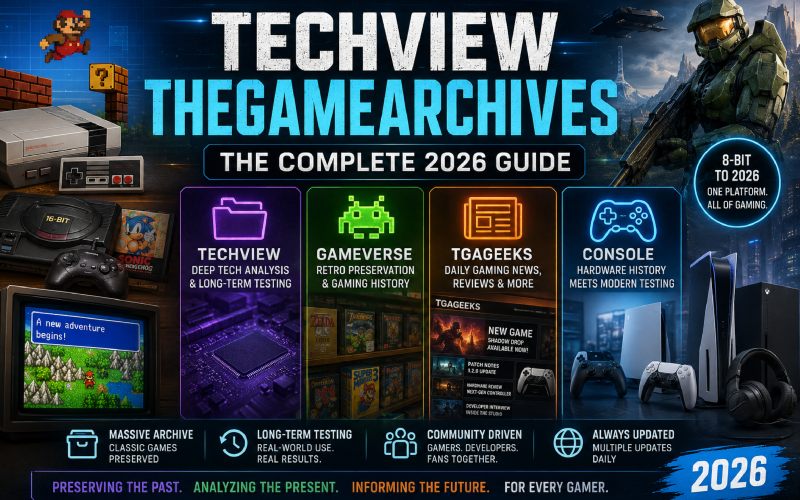
You’ve seen the name everywhere in gaming circles this year — but what exactly is TechView TheGameArchives, and why should you care? Most gaming sites push hype. This one stores history, tests hardware the honest way, and delivers daily news through its TGAGeeks feed. If you want one platform that covers retro preservation, console tech, and current gaming news together, this guide breaks it all down clearly.
Quick Facts: TechView TheGameArchives at a Glance
| Feature | Details |
| Platform Type | Gaming archive, tech analysis & news hub |
| Key Sections | TechView, Gameverse, TGAGeeks, Console |
| Primary Audience | Casual gamers, retro fans, tech enthusiasts |
| Content Format | Articles, reviews, hardware analysis, news updates |
| Update Frequency | Multiple times daily (news section) |
| Access | Free to read for most content |
| Coverage Span | Retro 8-bit titles through modern 2026 releases |
| Unique Value | Combines preservation + tech analysis + current news |
What Is TechView TheGameArchives?
At its core, TechView TheGameArchives is a digital platform built around two major purposes: it provides technology-focused gaming analysis and reviews, and it preserves classic games — especially older titles that might otherwise disappear from public memory.
Think of it less like a typical gaming blog and more like a structured library that also runs a newsroom. The “TechView” section goes deeper than most review sites. Coverage centers on gaming hardware behavior, engine updates, platform changes, and system performance tracked through long-term real-play conditions. Headlines follow evidence. Opinions follow data.
What stood out to me in researching this platform is the deliberate contrast with standard gaming media. Most outlets test a product at launch, publish a score, and move on. TechView exists to review gaming technology through long-term use — because performance patterns that emerge over months tell a different story than a day-one benchmark.
This approach has earned the platform a loyal audience among readers who want to understand why a game performed a certain way — not just what score it received. For similar deep-dive digital media coverage, our RevolverTech Gaming analysis covers another corner of gaming media worth reading alongside this.
The Gameverse: TheGameArchives’ Broader Ecosystem
The Gameverse is the connective tissue of the entire TheGameArchives platform. It ties together retro preservation, hardware coverage, TGAGeeks news, and community discussion into one organized space.
Its most important function is bridging eras. By preserving 8-bit classics alongside modern hardware guides, the Gameverse makes it possible to trace a straight line from how games were built in 1985 to how they’re built today. That context is missing from almost every other gaming site operating right now.
How to Navigate the Gameverse Without Getting Overwhelmed
The platform packs a lot of information into one place. The most practical approach:
- Start with the New Arrivals section to see the latest files added to the archive vault
- Check the updates log for any improvements or fixes to games you follow
- Subscribe to the newsletter so breaking updates reach you directly
- Use the community-contributed news feed under TGAGeeks for grassroots coverage
The Gameverse also carries a community angle that separates it from top-down editorial outlets. Regular players contribute discoveries alongside the editorial team — which produces more honest, textured coverage of what the gaming world actually cares about on any given day.
TGAGeeks: The Fast-Moving News Arm of TheGameArchives
TGAGeeks is where the platform shifts from archival depth to real-time speed. It covers breaking news, game reviews, patch notes, trend analysis, hardware releases, and platform-specific updates — in one structured feed that serves both casual readers and dedicated fans.
What TGAGeeks Covers
| Content Type | Description |
| Daily News | Industry headlines, studio announcements, game launches |
| Game Reviews | Tested by editorial team + cross-checked with community feedback |
| Patch Notes | Verified patch and update tracking across all major platforms |
| Shadow Drop Alerts | Games announced and released the same day — tracked in real time |
| Hardware Coverage | Controllers, headsets, accessories — benchmarked under pressure |
| Trend Analysis | Why the industry moves in a given direction, not just what changed |
| Developer Interviews | First-hand reporting from studios and industry events |
The section’s review philosophy is worth noting separately. TGAGeeks holds itself to a clear standard: a review must say whether a game is fun, stable, and worth buying. A news post must show what a patch actually changed for players. A trend article must explain why the industry moved — not just report that it did.
That standard separates TGAGeeks from aggregators that repost press releases. For readers who want similar clarity applied to non-gaming digital media, our PressVibePulse honest review applies the same editorial lens to a different content platform.
TheGameArchives Console Section: Hardware History Meets Modern Testing
The console section is where TechView’s analytical approach and the archive’s historical depth intersect most clearly. It covers both current-gen hardware (controllers, headsets, SSDs) and the technical story of every major console generation going back to the 8-bit era.
Console Coverage by Era
| Era | Key Technical Focus |
| 8-bit (NES/SMS) | Sprite limits, PPU constraints, sound chip architecture |
| 16-bit (SNES/Genesis) | Mode 7 rendering, blast processing, audio chip differences |
| 32/64-bit transition | Polygon counts, early 3D rendering, the CD-ROM shift |
| 6th & 7th Generation | Disc media, online connectivity, downloadable content rise |
| Current-gen (2020–2026) | SSD load optimization, ray tracing, frame delivery analysis |
The technical specifics the platform documents go well beyond nostalgia. For example: the NES Picture Processing Unit allowed exactly 64 sprites on screen, each limited to 8×8 or 8×16 pixels with specific color constraints. Developers worked around those limits creatively — and the console section documents exactly how. Mode 7 on SNES created pseudo-3D effects through hardware-accelerated texture mapping of background layers, a technique the section explains with enough technical depth to be genuinely educational.
According to the Entertainment Software Association’s 2024 industry report, over 65% of American adults play video games, with retro gaming representing one of the fastest-growing segments. Understanding the hardware history behind those classic titles adds real context — which is exactly what this section delivers.
For current-gen hardware, the testing methodology mirrors the TechView approach: long-term use, not launch-day impressions. A controller gets tested for button responsiveness after 200 hours, not two.
Why Gaming Preservation Matters More Than Most Sites Admit
Most competitors covering TechView TheGameArchives focus on what the platform offers today. What they miss is the larger problem it’s solving — and why that problem is getting worse.
The gaming industry loses digital history faster than it creates documentation. Servers shut down. Digital storefronts close. Hardware fails. Physical media degrades. According to a 2023 report by the Video Game History Foundation, 87% of classic games are out of print and effectively inaccessible to the public through legitimate channels. That’s not a niche concern — it’s a fundamental challenge for anyone who cares about cultural history.
TechView TheGameArchives addresses this by documenting not just the games themselves, but the technology behind them. A game without its technical context is data. With context — what hardware constraints shaped its design, what trade-offs developers made, what rendering tricks they used to push past hardware limits — it becomes documented history.
This preservation-first philosophy also explains why the platform covers AI, cloud gaming, and next-generation engines alongside retro archives. The goal isn’t nostalgia — it’s continuity. Understanding where gaming technology came from makes it easier to understand where it’s going.
For a comparison of how digital platforms manage long-term content value in adjacent spaces, our OnlyWorkMoods.com review examines a different type of content platform navigating similar questions about archival and relevance.
TechView TheGameArchives vs. Other Gaming Sites: A Direct Comparison
Most gaming websites fall into one of three categories: news aggregators, review sites, or community forums. TechView TheGameArchives doesn’t fit cleanly into any of them — which is both its strength and its trade-off.
| Criteria | TechView TheGameArchives | Standard Gaming Blog | Specialized Tech Site |
| Scope | News + archive + tech analysis | News + reviews only | Tech analysis only |
| Historical Depth | Full console history documented | Current-gen focus | Hardware specs only |
| Review Methodology | Long-term use testing | Launch-day impressions | Benchmark-focused |
| Community Input | Integrated into news feed | Comment sections only | Minimal community role |
| Preservation Focus | Core mission | Not a priority | Not a priority |
| Access Cost | Free for most content | Varies | Often paywalled |
The trade-off is real: a platform doing this many things simultaneously may not be the absolute fastest for breaking news, and its hardware analysis may not go as deep as a lab-focused outlet like Digital Foundry. But for a reader who wants historical depth, current news, and hardware analysis in one place — without switching between three different sites — TechView TheGameArchives fills a gap no single competitor currently covers.
Frequently Asked Questions
What is TechView TheGameArchives in simple terms?
It’s a gaming platform that combines a digital archive of classic games with technology analysis and current gaming news. The TechView section focuses on hardware behavior, engine updates, and long-term system performance — making it more analytical than most gaming blogs.
What is the Gameverse section?
The Gameverse is the platform’s broader content ecosystem. It connects retro gaming history, modern hardware coverage, TGAGeeks daily news, and community-driven updates into one organized space. Think of it as the connective layer between all other sections.
What does TGAGeeks actually cover?
TGAGeeks handles daily gaming news, honest reviews tested by the editorial team, patch note tracking, shadow drop alerts, hardware accessory coverage, and developer interviews. It’s the fast-moving news arm of the platform.
Is TheGameArchives console section useful for modern gamers?
Yes. While it covers retro hardware in significant depth, the console section also benchmarks current-gen controllers, headsets, and accessories through long-term use testing — making it practical for anyone shopping for new gear today.
Is the content on TechView TheGameArchives free?
Most content is free for public access. The platform is designed as a community resource, not a subscription gate. The newsletter is the main opt-in channel for staying current with updates.
How often does TheGameArchives update?
The TGAGeeks news feed updates multiple times daily. The archive and TechView analysis sections update less frequently but with greater depth — new hardware reviews and preservation posts appear regularly throughout the week.
Who is this platform built for?
The platform serves a wide range: young gamers discovering 1990s and 2000s classics for the first time, older fans revisiting familiar titles, tech enthusiasts interested in hardware history and engineering, and developers who want documented context on how earlier systems worked.
What makes TechView different from standard hardware review sites?
Most hardware review sites test products at launch and publish immediately. TechView tracks performance over months of real use. That long-term methodology surfaces patterns — performance degradation, firmware improvement, build quality issues — that launch-day benchmarks can’t detect.
Final Thoughts
TechView TheGameArchives has built something rare: a platform that treats gaming history as genuinely worth preserving, tests hardware the way it should be tested (long-term), and delivers daily news without abandoning editorial standards.
The Video Game History Foundation’s finding that 87% of classic games are inaccessible through legitimate channels makes platforms like this more important than most gaming coverage acknowledges. The archival mission isn’t a feature — it’s the foundation everything else is built on.
Whether you’re a casual player who wants clear hardware advice before buying a controller, a retro fan who wants to understand why your favorite SNES game looked and played the way it did, or a developer studying the engineering decisions of earlier console generations — this platform gives you something most sites don’t: context that holds up over time.
Disclaimer: All platform descriptions and feature details are based on publicly available information as of June 2026. Platform features may change over time. This article is for informational purposes only.