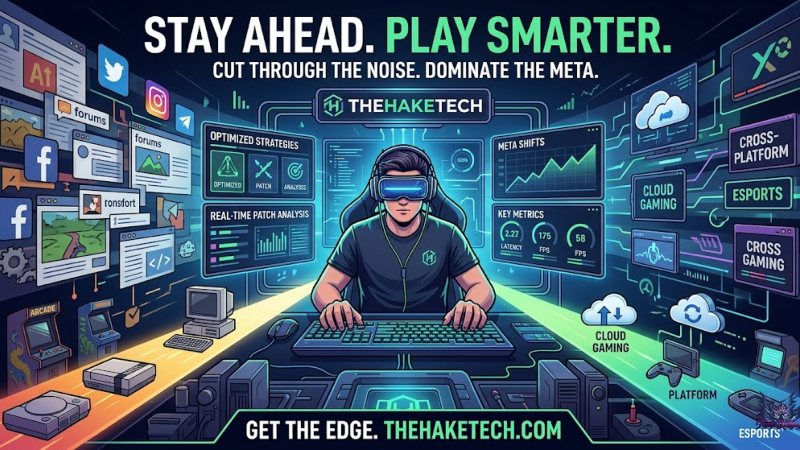
You’ve been there. You boot up your game, your squad is three patches ahead of you, and somebody just used a mechanic you’ve never even heard of. You lose. Again. That feeling — the one where the whole world moved on without you — is more common than gamers like to admit. It gets worse. Gaming news is scattered everywhere. YouTube. Reddit. Twitter. Discord servers. Dozens of tabs open. Still nothing concrete. By the time you find a reliable source, the meta has already shifted. That’s not a skill problem. That’s an information problem.
Here’s the real deal: the players who consistently win aren’t always the most talented. They’re the most informed. And that’s exactly why Thehaketech exists — to cut through the noise and put every gamer back in the driver’s seat.
How Gaming Has Evolved — Thehaketech Tracks Every Step
Think of it this way: gaming in 1995 meant blowing dust out of a cartridge and praying the SNES would cooperate. Today, you’re streaming 4K titles from a cloud server with zero hardware. That jump didn’t happen overnight, and understanding it matters.
Arcade cabinets gave way to home consoles. Home consoles gave way to PCs. PCs gave way to mobile. And now? Everything is giving way to cloud gaming. Services like Xbox Cloud Gaming and NVIDIA GeForce NOW let you run AAA titles on a $200 Chromebook. That’s wild. That’s also the reality right now.
In my experience, most gamers feel this shift but don’t fully grasp what it means for their strategy and setup. The hardware race that dominated the 2000s is cooling off. What heats up instead is connectivity, optimization, and platform agility. If your gaming knowledge stopped updating in 2018, you’re playing a completely different game than everyone else.
Tracking how gaming has evolved thehaketech-style means looking at more than just console releases. It means watching cloud latency improvements, subscription model wars, indie scene explosions, and cross-platform integration. Each of those shifts changes how games are built, priced, and played.
| Worth Noting: Cloud gaming adoption has grown significantly since 2022, and players who take the time to optimize their connection setup for cloud-specific play tend to notice a real difference in consistency and responsiveness within the first few weeks. |
|---|
Old-School vs. Modern Tech Gaming — Side by Side
| Category | Old-School Gaming | Modern Tech Gaming |
|---|---|---|
| Speed | Slow load times, cartridge delays | Instant cloud streaming, sub-second load |
| Graphics | 8-bit / 16-bit pixel art | 4K/8K ray-traced, photorealistic worlds |
| Community | Local LAN parties, couch co-op | Global multiplayer, Discord, live streaming |
| Updates | Physical patches, rare bug fixes | Real-time patches, live event drops |
| Access | Buy hardware per console | Play on any device via the cloud |
| Info Source | Gaming magazines, word of mouth | Thehaketech & live news feeds |
Gaming Hacks Thehaketech Swears By — Real Strategies That Actually Work
Not every “gaming hack” is worth your time. I’ve seen players waste hours chasing tips that were patched out six months ago. The difference between a useful tip and clickbait fluff is whether it still works today. Here’s what actually moves the needle.
First
Optimize your network before your hardware. Most players shell out for a new GPU when their real bottleneck is ping. A wired Ethernet connection and a QoS-enabled router can cut latency by 30–60ms. That’s the difference between getting eliminated and making the clutch play.
Beyond the physical connection, the way we use software has shifted; industry experts now argue that the best gaming upgrade in 2026 isn’t raw hardware, but rather leveraging AI upscaling and frame generation to maximize existing rigs.
Second:
Study patch notes like a professional. Every major game releases patch notes. Most players ignore them. The ones who read them gain a two-to-three day edge on the new meta every single update cycle. Gaming hacks thehaketech covers these notes in plain language so you don’t have to decode developer jargon.
Third:
Use VOD review. Watch your own gameplay. Not for entertainment — for clinical analysis. Where did your decision-making break down? What did your opponent see that you didn’t? This technique comes straight from esports coaching, and it translates to every genre from FPS to strategy games.
On the other hand, some shortcuts genuinely work. Keybind optimization, game-mode monitor settings, and in-game audio configuration are all legal, accessible, and massively underused. These are the gaming hacks that don’t get patched because they’re not exploits — they’re smart setups. For those looking to go even deeper into system-level optimization, choosing an OS built for performance is a major edge; check out this guide on the top Linux gaming distributions for 2026 to see how open-source platforms are outperforming traditional setups.
| Pro-Tip: Set a weekly 20-minute “patch audit” session. Read the patch notes, adjust your loadout or build, then spend 30 minutes in practice mode. Players who do this consistently outperform those who learn from losing matches alone. |
|---|
How to Keep Up with Gaming News — Thehaketech Makes It Simple
Real talk: most gaming news sites bury the important stuff under sponsored posts and clickbait rankings. Learning how to keep up with gaming news thehaketech-style means choosing your sources deliberately instead of consuming randomly. The core problem isn’t a lack of information. It’s too much of the wrong kind. A story about a celebrity playing a popular title trends harder than actual patch analysis. That skewed signal makes it harder to stay sharp when it counts.
Here’s a system that works. Choose two or three focused outlets. Follow them consistently. Cut everything else. Then layer in community-based monitoring — a Discord server, a subreddit, or a gaming updates thehaketech feed that surfaces only relevant changes to your specific games. Gaming updates thehaketech delivers this in a structured way. Instead of scrolling through noise, you get categorized updates: competitive patches, new releases, hardware news, and regional esports results. It’s the difference between a fire hose and a water tap.
I’ve seen players struggle with this more than almost any other part of gaming growth. They’re skilled. They’re dedicated. But they’re always one update behind because their information diet is chaotic. Fixing that alone can shift your win rate faster than 50 hours of raw practice. Also worth reading for a broader digital media perspective: PressVibePulse.com — Is It Really the Heartbeat of the Digital World? — a solid breakdown of how digital platforms shape information flow in 2025.
| Worth Noting: Many competitive players build a short, structured news-check into their pre-practice routine rather than treating it as optional — a habit that’s become common in professional training approaches for games like Valorant and League of Legends. |
|---|
Staying Ahead Means Knowing What Others Miss
The gaming world doesn’t wait. New metas emerge within hours of a patch. Tournament formats shift. Hardware becomes obsolete faster than most people’s upgrade cycles. Staying ahead isn’t about obsessing over every update — it’s about having the right filter. Think of it this way: a doctor doesn’t read every medical journal. They follow curated, peer-reviewed summaries from sources they trust. Gamers who win consistently do the same thing. They trust fewer sources, but they trust them deeply.
One area that’s becoming increasingly important: understanding financial tech integrations in gaming. Play-to-earn models, in-game economies, and blockchain gaming are reshaping what “owning” a game even means. For context on how new tech ecosystems are evaluated before you commit to them, this review is a useful read: BitClassic Applewhite Review — What Nobody Tells You Before You Sign Up.
The players who understand these systems early gain economic advantages inside gaming ecosystems that purely-skill-focused players never see coming.
Final Verdict
Gaming in 2026 is fast, layered, and unforgiving to the uninformed. The skill gap between players isn’t growing — the information gap is. And that gap is closable. It takes deliberate source selection, consistent patch awareness, smart setup optimization, and the discipline to study your own play.
Thehaketech exists at the intersection of all of that. Not as a shortcut. As a system. A place where how gaming has evolved thehaketech-style coverage meets real gaming hacks thehaketech-grade strategy, where gaming updates thehaketech delivers mean something, and where knowing how to keep up with gaming news thehaketech-first approach separates the serious from the casual. The tools are there. The knowledge is available. The only question left is a real one:
When AI begins generating game patches in real time, adapting to each player’s individual skill level — will the information systems we build today be fast enough to keep up, or will the game finally start playing us?
Sarah Jenkins | Content Reviewer
Sarah Jenkins writes reviews and guides for The Fame Blogs, focusing on evaluating digital tools, platforms, and gaming trends so readers can make informed decisions before spending money or time on them.