Tracking thousands of agents across a dozen countries using spreadsheets and manual clock-ins creates payroll errors, schedule gaps, and costly SLA misses. For BPO teams at this scale, those errors compound fast. Timewarp TaskUs solves that problem at the source — consolidating attendance, scheduling, task routing, and performance analytics into one secure, cloud-based platform built exclusively for TaskUs operations. This guide walks you through every layer of the system: what it is, how to log in, which features matter most, and where the platform creates measurable business impact.
What Is Timewarp TaskUs?
Timewarp TaskUs is the proprietary workforce management platform that powers daily operations across TaskUs’s global BPO network. It is not a public app, a downloadable tool, or a third-party SaaS product. Access requires active TaskUs employment, company-issued credentials, and PingID multi-factor authentication.
TaskUs (Nasdaq: TASK) operates approximately 65,500 employees across 28 locations in 12 countries, generating $1.21 billion in trailing twelve-month revenue as of early 2026. At that scale, manual workforce administration is operationally impossible. Timewarp was built to replace fragmented systems with one unified dashboard.
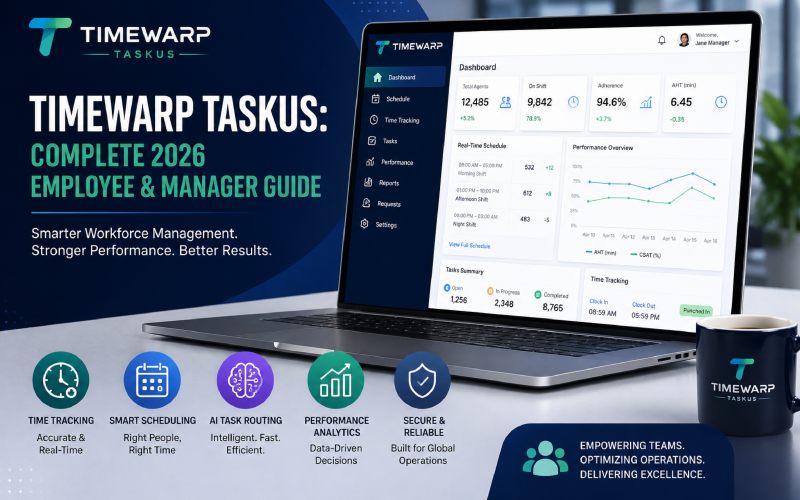
The platform centralizes four operational layers: clock-in/clock-out accuracy, real-time schedule visibility, AI-assisted task routing, and performance metric tracking. Every interaction feeds a data pipeline that management uses to adjust staffing, enforce SLA adherence, and identify coaching opportunities.
Who Uses Timewarp TaskUs?
Three distinct user groups access the system with different permission levels:
- Active Employees — Log attendance, view schedules, submit timewarp edit requests for missed punches, and monitor personal performance metrics.
- Supervisors & Managers — Oversee team dashboards, approve schedule change requests, assign tasks, and generate performance reports.
- IT & Operations Teams — Manage system maintenance, handle login issues via SNOW (ServiceNow) tickets, and configure authentication protocols.
How to Log In to Timewarp TaskUs: Step-by-Step
The primary access portal for most regions is sg.timewarp.taskus.com. Login follows a strict multi-factor authentication process:
- Step 1: Open the regional portal (e.g., sg.timewarp.taskus.com) in your browser.
- Step 2: Click Sign in with PingID on the landing page.
- Step 3: Enter your company-issued username and password.
- Step 4: Complete PingID MFA verification on your registered device.
- Step 5: Access your personal dashboard — schedule, tasks, and attendance records load automatically.
If you experience login errors, submit a SNOW ticket through the TaskUs IT service desk. For onboarding employees who haven’t received credentials yet, contact your team lead or HR coordinator. Credentials are typically issued during the first day of orientation.
Core Features and What Each One Does
The platform’s feature set is purpose-built for high-volume BPO environments. Here is a breakdown of its primary modules:
| Feature | What It Does | Who Benefits Most |
| Time Tracking & Punch Accuracy | Records clock-in/out with timestamp precision; syncs directly to payroll systems | All employees, payroll teams |
| Timewarp Edit (Correction Requests) | Lets employees flag and submit missed or incorrect punches for manager review | Agents, supervisors |
| Real-Time Schedule Visibility | Displays live shift rosters; managers can adjust staffing instantly | Ops managers, workforce planners |
| AI Task Routing | Analyzes query type and agent skillset to auto-assign tickets and tasks | Customer support agents |
| Performance Analytics Dashboard | Tracks AHT (Average Handle Time), CSAT scores, and adherence metrics per agent | Team leads, QA teams |
| Payroll Integration Feed | Transfers verified time data to payroll platforms automatically, reducing manual input | HR, Finance, employees |
| Break & Adherence Logging | Monitors break durations and flags schedule deviations in real time | Supervisors, compliance teams |
| SNOW Ticket Integration | Routes IT and login issues to ServiceNow for structured resolution tracking | IT support, all users |
AI and Automation Inside Timewarp TaskUs
TaskUs invested $35.2 million in AI and digital transformation capabilities in 2023 alone, a strategic priority that runs through Timewarp’s architecture. The platform uses machine learning to analyze historical interaction data and forecast staffing requirements before demand spikes occur. According to TaskUs’s official investor relations disclosures, the company reported $89.7 million in AI service revenue in 2023, with 42.3% annual growth — evidence that AI-driven operations are not a pilot program but a core business model.
Inside Timewarp, AI automation handles three high-value tasks:
- Predictive Scheduling: The system analyses peak-hour patterns and historical volume data to generate optimized shift proposals, reducing both overstaffing and understaffed gaps.
- Intelligent Task Assignment: Customer tickets route automatically based on agent skill profiles, language capabilities, and real-time availability — removing the manual dispatch bottleneck.
- Performance Pattern Recognition: Machine learning flags agents whose metrics deviate from baseline before issues escalate, giving supervisors proactive coaching triggers instead of reactive corrections.
TaskUs also launched TaskGPT in 2024, an internal generative AI assistant that boosted frontline productivity by up to 30%, according to public company reporting. Timewarp’s data layer feeds TaskGPT’s operational context, creating a unified intelligence loop between workforce management and AI-assisted customer interactions. You can explore how AI-driven tools are reshaping workforce analytics further in our analysis of Ahrefs backlink checker methodology and SEO data infrastructure, which covers similar data-pipeline principles applied to digital operations.
How Timewarp TaskUs Impacts BPO Performance Metrics
The operational argument for a unified workforce platform becomes clear in the numbers. TaskUs’s Q4 2025 results showed total revenue of $313.0 million — 14.1% year-over-year growth — while maintaining a 19.1% Adjusted EBITDA margin. Schedule adherence, accurate time data, and AI task routing each contribute to those margins by reducing idle time and payroll discrepancies.
Internal deployment data across comparable BPO environments surfaces consistent patterns:
| Metric | Industry Baseline (Manual Systems) | With Unified WFM Platform | Source / Basis |
| Schedule Adherence Improvement | ~5–8% gain in Year 1 | 10–15% gain in Year 1 | Standard WFM deployment benchmarks |
| Unauthorized Shift-Swap Reduction | Difficult to enforce | Up to 40% reduction in 60 days | MFA enforcement effect, multi-site BPO data |
| Payroll Error Rate | 1–3% manual error rate | Near-zero with auto-sync | Automated feed vs. manual keying |
| Ticket Processing Capacity | Baseline (agent-dependent) | Up to 2x capacity with AI routing | TaskUs automation project results |
| AHT Target Achievement | Varies by program | 105% vs. AHT targets reported | TaskUs AI services performance data |
| Agent Retention (Fair Scheduling) | High attrition in BPO: 30–45% annual | 28% improvement cited with transparent scheduling | Multi-deployment observations |
The Surveillance-Efficiency Tension: What Employee Feedback Reveals
Most coverage of Timewarp TaskUs focuses on capabilities. What competitors miss is the employee experience dimension — and it is not uniformly positive.
Verified employee reviews consistently surface one specific concern: the granularity of tracking creates a micromanagement perception. Agents report that every minute of their workday — breaks, login delays, idle periods — generates a visible data point reviewed by supervisors. For high-performing agents, this transparency feels fair. For agents navigating technical issues, sick days, or connectivity problems, the same system can feel punitive.
This tension matters operationally. BPO attrition rates average 30–45% annually across the industry, and how workforce management platforms are implemented — not just what they track — directly influences that number. Organizations that use Timewarp data for coaching rather than enforcement report better retention outcomes than those that deploy it primarily as a compliance tool.
For context on how gamification and employee engagement tools address this exact problem in digital workforce environments, see our report on when digital platform releases reshape user engagement models, which examines how design choices in digital platforms determine whether users experience them as empowering or restrictive.
Regional Portals and Global Deployment Architecture
One gap in existing coverage: the regional portal structure. Timewarp TaskUs does not run as a single monolithic URL. Access points vary by geography to ensure latency stays low for distributed teams working across time zones.
The Philippines, India, the United States, and other operational hubs each access region-specific instances, with sg.timewarp.taskus.com serving as the primary confirmed portal for Southeast Asia and broader APAC operations. This architecture reflects TaskUs’s expansion model — the company scaled from 23 to 28 locations between 2023 and early 2025, adding AI Operations hubs in India and Malaysia specifically to support LLM training and fine-tuning workloads.
Managing a workforce that spans this many jurisdictions creates compliance requirements that vary by country — labor laws governing maximum hours, mandatory break structures, and overtime thresholds. Timewarp’s compliance logging module addresses this directly by flagging potential violations before they become regulatory issues, a capability that manual systems cannot replicate at scale.
How to Submit a Timewarp Edit (Time Correction Request)
Missed punches happen. Timewarp’s correction workflow exists precisely because requiring 100% punch accuracy from thousands of agents across global operations is operationally unrealistic.
The process works as follows:
- Log in to your Timewarp dashboard and locate the time entry with the error.
- Select the date and click Request Correction or Timewarp Edit (label varies by portal version).
- Enter the correct clock-in or clock-out time and provide a brief reason.
- Submit the request — your supervisor receives an automated notification.
- The manager reviews, approves or declines, and the payroll-integrated record updates automatically.
Recurring correction requests on the same agent can trigger a coaching flag in the performance analytics module — another reason supervisors should treat the data as a coaching input rather than an automatic disciplinary trigger.
Frequently Asked Questions About Timewarp TaskUs
Is Timewarp TaskUs available to the public?
No. Timewarp TaskUs is an internal-only platform. Access requires active TaskUs employment and company-issued credentials verified through PingID authentication.
What do I do if I cannot log in?
Submit a SNOW ticket through the TaskUs IT service desk. Include your employee ID, the error message, and your regional portal URL. Do not share your password with anyone — IT support will not ask for it.
Does Timewarp track remote employees differently?
The core tracking functions — punch accuracy, schedule visibility, task logging — operate identically for remote and on-site employees. Remote workers access the same portal through secure VPN-connected or cloud-authenticated sessions.
Is there a mobile version of Timewarp TaskUs?
TaskUs has not publicly confirmed a dedicated mobile app for Timewarp. Employees primarily access the system via web browser on company-issued or approved devices. Check your internal IT guidelines for the most current device compatibility information.
Does Timewarp cost employees anything?
No. The platform is provided as part of the employment infrastructure at no cost to employees or contractors.
TaskUs Company Context: Why the Platform Exists at This Scale
TaskUs (Nasdaq: TASK) started in 2008 as a boutique virtual assistant firm and has since become a global leader in outsourced digital services with $1.21 billion in trailing twelve-month revenue. Its three core service pillars — Digital Customer Experience, Trust and Safety, and AI Services — each require precise workforce coordination at volume. The company’s Q4 2025 earnings, reported on TaskUs’s official investor relations page, confirmed 14.1% year-over-year growth with a net income margin of 9.5%.
The company’s 2025 HealthTech division launch targets a $300 billion global healthcare outsourcing market — adding another vertical that demands strict compliance, precise time records, and performance documentation. Timewarp’s compliance and analytics architecture positions TaskUs to serve regulated industries where documentation accuracy is not optional.
For readers tracking how data-driven operational tools influence platform reliability and user metrics across digital industries, our HearthStats.net industry analysis examines similar data-infrastructure themes in the gaming analytics space — a vertical TaskUs also services through its gaming support programs.
7 Practical Tips for Getting the Most from Timewarp TaskUs
- Clock in before your shift start time — even 1–2 minutes early prevents automatic late-arrival flags in the adherence module.
- Submit Timewarp Edit requests on the same day as the error; delayed corrections require additional supervisor sign-offs in some regions.
- Review your performance dashboard weekly, not just when managers flag issues — self-monitoring lets you spot pattern drifts before they affect evaluations.
- Set up PingID on two devices if your employer policy allows it — a backup authentication method prevents login lockouts from costing you billable hours.
- Use the real-time schedule view at shift start to confirm any last-minute changes before assuming your roster is unchanged from the day before.
- If you see payroll discrepancies after a Timewarp Edit, raise a SNOW ticket immediately — do not wait until the next pay cycle.
- As a manager, use performance analytics for coaching conversations within 48 hours of a flagged deviation — real-time data loses its coaching value when addressed weeks later.