
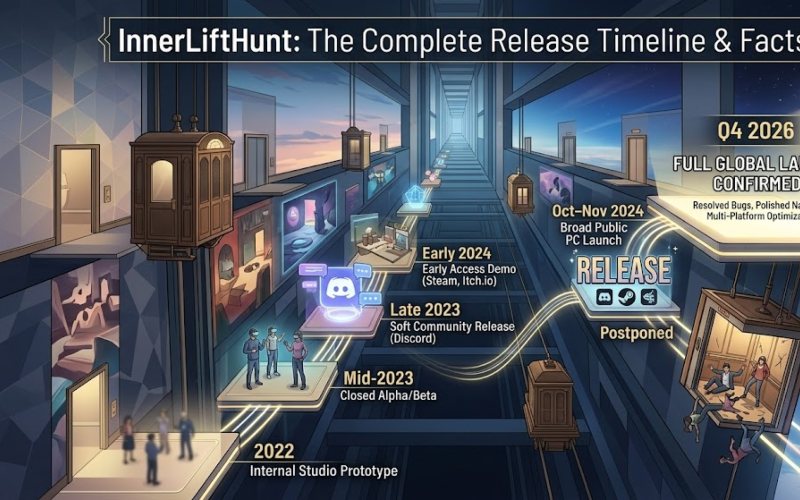
You searched for a release date and got ten different answers. 2020. 2023. 2024. 2025. Every article contradicts the last, and none of them explain why. That confusion is not an accident — it is a direct result of how InnerLiftHunt entered the world. This guide cuts through the noise, maps every confirmed milestone on a single timeline, and explains exactly why the game faced postponement on its way to a Q4 2026 full launch.
What Is InnerLiftHunt? A Quick Context Check
InnerLiftHunt is a psychological horror RPG set inside an infinite, ever-shifting skyscraper. Players explore floors that each represent a different layer of the human mind. Every corridor, elevator shaft, and locked room holds a secret tied to memory and trauma.
The game blends environmental storytelling, surreal exploration mechanics, and strategic decision-making. There are no cutscenes — the narrative emerges entirely from what players discover and choose. Developer AetherFlux Studios built the title around the concept of emotional ascension, which explains the “Lift” in its name.
The studio first hinted at the project through cryptic social media posts and a minimal teaser site. That deliberate mystery created a cult following long before any playable build existed. For more on how niche gaming communities shape titles like this, see our PlayBattleSquare 2026 guide, which tracks a similar community-first growth pattern in indie gaming.
When Was the Game InnerLiftHunt Released? The Definitive Answer
Quick Answer: InnerLiftHunt entered closed beta in mid-2023, reached a broad public launch on PC platforms in late 2024, and targets a full global release in Q4 2026 after a confirmed postponement.
The confusion around its release date stems from one core fact: InnerLiftHunt did not follow a traditional single-day global launch. Instead, it used a staggered rollout strategy common among modern indie titles — and each stage of that rollout produced a different “release date” depending on who you ask.
The Full Phase-by-Phase Breakdown
Here is every confirmed milestone in InnerLiftHunt’s launch timeline, from internal prototype to current status:
| Period | Development Phase | Platform / Channel | Audience |
| Early 2022 | Private prototype builds | Internal studio testing only | Not public |
| Mid-2023 | Closed alpha / beta | Invite-only playtesting groups | Select testers |
| Late 2023 | Soft community release | Discord & indie forums | Niche community |
| Early 2024 | Early access / demo | Steam, Itch.io demo pages | PC players |
| Oct–Nov 2024 | Broad public launch | Steam, GOG, Itch.io | PC + limited console |
| Late 2025 → Jan 2026 | Postponed full launch | Delayed due to QA & bugs | Rescheduled Q4 2026 |
The table above explains why sources cite wildly different dates. A player who discovered the game through a Discord leak in late 2023 calls that the release. A Steam buyer in October 2024 marks that as launch day. Both are correct within their own frame of reference.
Why October–November 2024 Stands as the Primary Public Release
The late-2024 window represents the point when InnerLiftHunt became accessible to a general gaming audience without a private invite or waitlist. Steam and Itch.io listings went live, gameplay clips spread across YouTube and Twitch, and search interest spiked for the first time.
That said, the game remained in an evolving state. AetherFlux Studios continued patching and adjusting core systems — which directly contributed to the postponement announced for the fully polished version.
Why Was the InnerLiftHunt Game Postponed?
The postponement of InnerLiftHunt’s complete release is not a single-cause story. AetherFlux Studios issued an official statement confirming the delay, citing overlapping technical and strategic reasons rather than one isolated problem.
| Reason for Delay | Specific Detail | Priority |
| Critical QA Bugs | Elevator physics caused players to fall through floors between levels — a game-breaking immersion failure | High |
| Multi-Platform Optimization | Performance instability across PC configurations, SSD vs HDD load times, and mobile battery constraints | High |
| Narrative Pacing Fixes | Playtesters flagged jarring story transitions; key scenes and dialogue required rework | Medium |
| Server Infrastructure | Online features required upgraded backend to support simultaneous global players at launch | Medium |
| Investor & Funding Timing | Studio in final-stage talks with a major investor — an unpolished release would weaken studio valuation | Strategic |
| Market Window Conflict | Original Q1 2026 window clashed with high-profile releases; Q4 2026 offers a clearer competitive lane | Strategic |
The Bug That Became a Community Talking Point
Among all the technical issues, one stood out publicly: a critical elevator physics bug. In early builds, players would fall through the floor during level transitions — a particularly damaging flaw for a game whose entire identity rests on vertical movement and immersive exploration.
The lead developer addressed it directly at a 2025 gaming expo, stating: “We would rather you wait three months for a scary game than play a broken game today.” That quote circulated widely in fan communities and became an informal mantra for the InnerLiftHunt audience.
The Strategic Delay: More Than Just Bugs
One dimension most articles miss entirely is the business strategy behind the postponement. According to insider reports, AetherFlux Studios was in final-stage talks with a major investor at the time of the original Q1 2026 release window. Releasing an unpolished build before closing that funding round would have weakened the studio’s valuation at a critical negotiation moment.
This pattern — where creative and financial timelines intersect — reflects a broader shift in how independent studios operate. Understanding that dynamic is essential for any gamer tracking the business side of indie development. Silicon-focused analysts like those writing at Silicon Insider have covered how funding pressure shapes product roadmaps across the tech and gaming sectors.
The “Release Date Confusion” Problem: A Unique Angle
Every competing article either picks one date and defends it, or lists the confusion without explaining it. Neither approach serves readers who want to understand what actually happened.
Why Indie Games Produce Multiple “Release Dates”
Modern independent games rarely launch in a clean, single moment. Platforms like Steam now support Early Access as a formal product state, and tools like Itch.io allow developers to share builds the moment they are playable. This creates a publish-as-you-build model that fragments the traditional idea of a launch.
InnerLiftHunt moved through at least four distinct access phases before its current postponed state. Each phase felt like a “release” to the players who experienced it. Journalists and bloggers who covered each phase wrote about their phase as if it were the definitive one — and that is the origin of every conflicting date you will find online.
This publish-as-you-build approach is now influencing broader digital content categories beyond gaming. Lifestyle and media publications tracking this shift include outlets like GlossyWise, which covers how serialized digital releases are reshaping audience expectations across entertainment formats.
The Signal That Matters: Search Volume
Regardless of which specific date counts as “official,” one data point is unambiguous: search interest in InnerLiftHunt accelerated in late 2024 and again in early 2026 when the postponement news broke. Both spikes correspond to moments when the game became more accessible or more discussed — not necessarily when any formal version shipped.
That search behavior tells you when the game was “released” in the most meaningful sense: when people cared enough to look it up.
What the Q4 2026 Target Means for Players
AetherFlux Studios moved the full launch to Q4 2026 — a window chosen deliberately to avoid the crowded spring release calendar. The studio targets a less competitive retail environment to give InnerLiftHunt maximum day-one visibility.
- All previously discovered critical bugs, including the elevator physics flaw, are resolved before launch
- Server infrastructure upgrades complete to support global simultaneous access
- Narrative pacing reworked based on playtester feedback across key scenes
- Multi-platform availability confirmed, with console optimization finalized
- Marketing campaign timed to build momentum into a cleaner market window
This is not the studio’s first delay — and history supports patience. Games that use extended QA cycles before a major launch routinely outperform rushed competitors in long-term player retention and review scores.
For a broader perspective on how quality-first release strategies affect long-term product success, the Game Developers Conference resource library offers well-documented case studies on delay-to-quality outcomes across the industry.
Players who want to track the confirmed Q4 2026 window should also monitor IGN’s indie coverage for any official announcements from AetherFlux Studios as the launch window approaches.

Sarah Jenkins is a seasoned Digital Content Strategist and lead reviewer for The Fame Blogs, where she contributes to their growing collaborative digital hub. With a strong background in web development and SEO, Sarah has spent over five years helping users navigate the digital landscape to find tools that actually work.
Specializing in productivity and online safety, she focuses on providing honest, data-driven critiques of emerging websites. When she isn’t deconstructing the latest tech trends, Sarah is dedicated to creating high-quality content that empowers readers to make smarter, safer choices online.