The landscape of software engineering is constantly shifting, but the core principles of logical thinking and structured architecture remain the bedrock of a successful career. For undergraduate students entering the field in 2026, the choice of a first programming language is more than just a technical decision; it is about choosing a mental framework. While Python offers simplicity and JavaScript dominates the web, C# (C-Sharp) has emerged as the most balanced ecosystem for those who want to understand how software actually works under the hood while remaining highly productive.
The challenge for modern students isn’t just learning to code; it’s learning to manage a massive academic workload while mastering complex syntax. Navigating high-level concepts like asynchronous programming or memory management can be overwhelming. Many students find that utilizing a reliable online assignment help australia service allows them to delegate standard academic essays so they can dedicate more “deep work” hours to their C# projects. This strategic balance is often what separates top-tier engineering students from those who burn out before graduation.
Why the Architecture of C# Matters
C# is a statically typed, object-oriented language developed by Microsoft. In 2026, its relevance has only grown due to its versatility in cloud computing, game development (via Unity), and enterprise-grade mobile applications. Unlike “loose” languages where you can get away with messy code, C# forces you to be disciplined. It requires you to define data types and structure your logic clearly.
While the technical benefits are clear, understanding the reality of the software ecosystem requires looking past the marketing. For instance, much like evaluating a specific platform or service, it’s important to look at a Bitclassic Applewhite review to understand what nobody tells you before you sign up for a new digital commitment.
This discipline is exactly why it is the perfect first language. It teaches you the “Modular Mindset.” When you learn C#, you aren’t just learning a language; you are learning the architectural patterns used by the world’s largest tech companies. Whether you eventually move into Java, C++, or even TypeScript, the foundational skills you build in the .NET ecosystem will translate seamlessly.
Bridging the Gap Between Theory and Practice
One of the biggest hurdles for undergraduates is the gap between classroom theory and industry application. University courses often focus on the “how,” but the industry cares about the “why” and the “how fast.” C# bridges this gap through its massive library support and the Integrated Development Environment (IDE) known as Visual Studio.
For a student, having a tool that catches your errors before you even run the code is like having a private tutor built into your laptop. However, even with the best tools, the logic behind object-oriented programming can be a stumbling block. If you find yourself stuck on a specific logic gate or a database integration, seeking specialized c sharp assignment help from experts at Myassignmenthelp Services can provide the clarity needed to move forward. Having a professional breakdown of a complex code snippet often acts as a catalyst, helping you understand the “why” behind the syntax more effectively than a textbook ever could.
C# vs. Other Popular First Languages
To understand why C# stands out in 2026, we can look at how it compares to other common entry-level languages in terms of career readiness and learning curve.
| Feature | C# (.NET) | Python | JavaScript |
| Primary Use | Enterprise, Gaming, Web | AI, Data Science | Frontend Web |
| Type System | Strong/Static | Weak/Dynamic | Weak/Dynamic |
| Performance | High | Medium | Medium |
| Career Path | Software Architect | Data Analyst | Web Developer |
| Learning Curve | Moderate (Structured) | Easy (Implicit) | Moderate (Fragmented) |
The Versatility Factor: From Web to Gaming
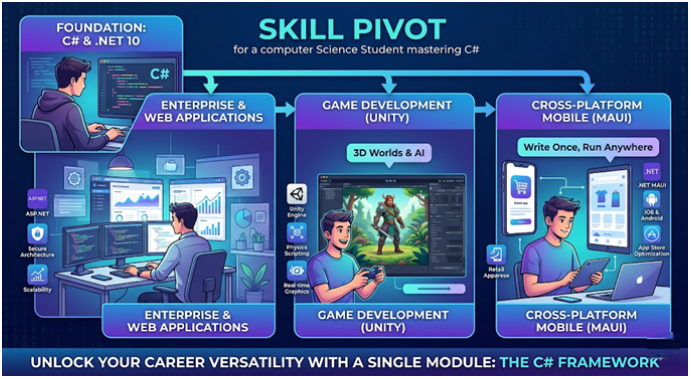
The “Write Once, Run Anywhere” philosophy of .NET 10 (the 2026 standard) means that a student learning C# can pivot into almost any niche.
- Game Development: Unity remains the industry standard for indie and mobile gaming. C# is the primary language here. If you want to build the next viral hit, C# is your ticket.
- Enterprise Applications: Global banks and healthcare providers rely on the security and scalability of C#. It is a “recession-proof” language.
- Cross-Platform Mobile: With MAUI (Multi-platform App UI), you can write one C# codebase and deploy it to iOS, Android, and Windows.
Mastering the Deep Work of Coding
Coding is an intensive cognitive task. In 2026, the digital distractions are higher than ever, and university curriculums have become more demanding. To truly master C#, you need hours of uninterrupted focus. This is where the concept of “Academic Delegation” becomes vital.
By outsourcing non-core subjects—like history electives or general business reports—students can protect their cognitive energy for the heavy lifting of C# architecture. It is not about taking a shortcut; it is about prioritizing the skills that will actually pay the bills once the degree is finished.
Future-Proofing Your Career
As we look toward the end of the decade, the integration of AI and machine learning into standard software is undeniable. C# has kept pace, offering robust libraries for AI integration within the Windows ecosystem. By starting with a structured language, you are essentially “future-proofing” your brain. You will understand how to debug AI-generated code because you understand the underlying structure that the AI is trying to emulate.
Final Thoughts for the 2026 Student
Choosing C# as your first language is a commitment to excellence. It is more challenging than Python, but it rewards you with a deeper understanding of computer science. It forces you to think like an architect, organize like a librarian, and solve problems like an engineer.
Balance your journey by using the resources available to you. Don’t be afraid to ask for help when the workload peaks, and stay curious about how the code you write today will power the applications of tomorrow.
Frequently Asked Questions (FAQ)
Q.1. Is C# harder to learn than Python?
Ans: Yes, initially. C# has more “boilerplate” code and stricter rules. However, these rules actually make it easier to debug and maintain large projects, which helps you become a better programmer in the long run.
Q.2. Can I get a job with just C# skills?
Ans: Absolutely. C# is one of the most in-demand languages for backend development and enterprise software. Most mid-to-large-scale companies have a .NET stack.
Q.3. Do I need a powerful computer to learn C#?
Ans: While Visual Studio is a heavy application, modern laptops from the last 3-4 years can handle it easily. You can also use Visual Studio Code, which is a lightweight alternative that works on almost any machine.
Q.4. How does C# help with game development?
Ans: C# is the scripting language for Unity, one of the world’s most popular game engines. Learning C# allows you to control character movement, physics, and game logic.
Q.5. Why is “static typing” important for beginners?
Ans: Static typing means you have to declare what kind of data a variable holds (like a number or text). This prevents many common bugs and helps you understand how computer memory works.
About The Author
My name is Min Seow, and I am a Senior Content Strategist dedicated to helping students navigate the complexities of modern higher education. With years of experience in the academic sector, I specialize in developing resource-driven content that simplifies technical challenges for undergraduates across various STEM and business disciplines.

Sarah Jenkins is a seasoned Digital Content Strategist and lead reviewer for The Fame Blogs, where she contributes to their growing collaborative digital hub. With a strong background in web development and SEO, Sarah has spent over five years helping users navigate the digital landscape to find tools that actually work.
Specializing in productivity and online safety, she focuses on providing honest, data-driven critiques of emerging websites. When she isn’t deconstructing the latest tech trends, Sarah is dedicated to creating high-quality content that empowers readers to make smarter, safer choices online.