

Most people don’t find out what a digital finance platform actually does until they’ve already put money in. That’s a problem. I’ve spent years watching people jump headfirst into platforms that promised easy returns, clean dashboards, and “next-gen” tools — only to end up confused, frustrated, or worse. So before you go any further with BitClassic Applewhite, let’s talk honestly about what it is, what it does well, and where you should pump the brakes.
What Is BitClassic Applewhite, Really?
Strip away the marketing language and BitClassic Applewhite is a digital finance platform built around cryptocurrency asset management and trading tools. It’s designed to sit in that middle space between a full brokerage and a basic crypto wallet — giving users access to market data, transaction processing, and multi-asset portfolio tracking under one roof.
In my experience, platforms like this usually fall into two camps: ones that over-promise and under-build, and ones that quietly deliver. BitClassic Applewhite leans closer to the second. It’s not flashy. But it does try to solve a real problem — the fact that managing digital assets across different platforms is genuinely annoying and inefficient.
Pro-Tip: If you’re new to digital asset platforms, don’t start with everything. Pick one feature — say, the market data dashboard — and learn it cold before you move on. Rushing is how people make expensive mistakes.
The Good, The Bad, and The Ugly
Let’s not pretend this platform is perfect. Here’s an honest breakdown.
The Good:
- The interface is genuinely clean. You don’t need a finance degree to figure out what you’re looking at.
- Real-time market data is actually real-time. I’ve seen platforms claim this and then show you numbers that are 15 minutes stale. That’s a dealbreaker in crypto. For peace of mind, you can always cross-reference these prices against global volume-weighted averages on CoinMarketCap.
- Multi-asset support means you’re not logging in and out of five different apps to check your holdings.
- Transaction speed is competitive. Delays in digital trading cost money. Period.
The Bad:
- New users often underestimate how much homework is still required. The platform simplifies access — it doesn’t simplify markets.
- Educational resources exist, but they’re surface-level. If you want to go deep on strategy, you’ll need outside sources.
The Ugly:
- Like every platform in this space, BitClassic Applewhite isn’t insulated from market volatility. No interface design protects you from a bad trade. I’ve seen people blame the tool when the issue was the decision.
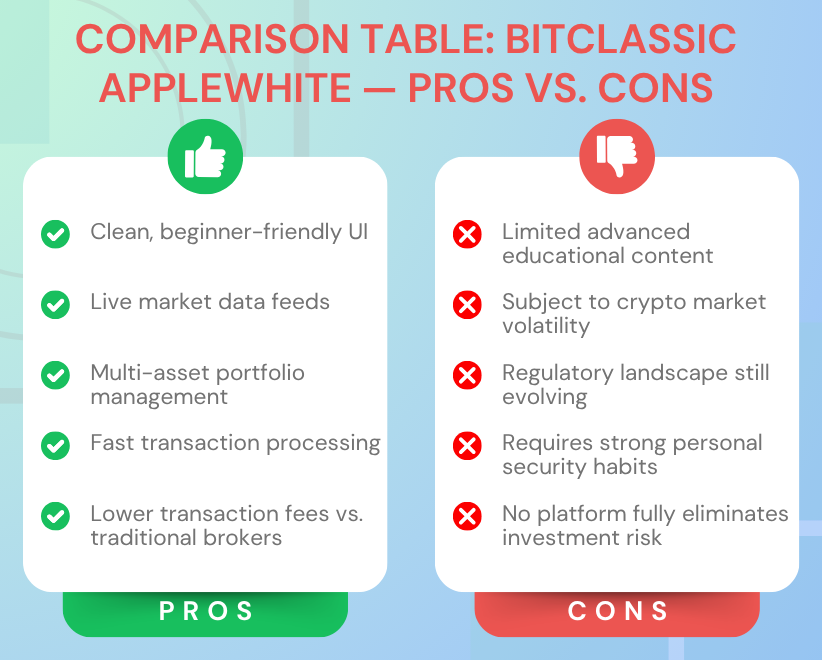
Comparison Table: BitClassic Applewhite — Pros vs. Cons
| Pros | Cons |
|---|---|
| Clean, beginner-friendly UI | Limited advanced educational content |
| Live market data feeds | Subject to crypto market volatility |
| Multi-asset portfolio management | Regulatory landscape still evolving |
| Fast transaction processing | Requires strong personal security habits |
| Lower transaction fees vs. traditional brokers | No platform fully eliminates investment risk |
Technical Breakdown (In Plain English)
Here’s the thing — you don’t need to understand blockchain at a doctoral level to use this platform. But understanding the basics helps.
BitClassic Applewhite works by connecting users to digital asset markets through a centralized interface. When you place a trade, the system routes your order, processes it, and updates your balance — usually in seconds. The backend uses encryption protocols to protect data in transit, and the account system includes multi-factor authentication, which you should absolutely turn on from day one.
Think of it this way: it’s less like building your own trading setup and more like using a well-organized cockpit where all the instruments are already calibrated. You still have to fly the plane.
If you’re inspired by this kind of streamlined digital efficiency and want to apply it to your own online projects, you might want to see how Netdesizn stacks up when it comes to building high-performance websites that stand out from the crowd.
On the wallet side, the platform supports multiple digital asset types in a single account view. That matters because switching between separate wallets or exchanges eats into both your time and your fees.
Expert Insight: Multi-layer authentication isn’t just a box to check. I’ve watched accounts get compromised because someone skipped this step. Don’t be that person. Turn it on, write down your recovery codes, and store them somewhere safe — not in your email drafts.
Who Is This Platform Actually For?
Not everyone. That’s the honest answer.
Beginners — Yes, this works for you. The interface lowers the learning curve significantly. But “easier to use” doesn’t mean “easier to profit.” Go in with realistic expectations and a commitment to learning as you go.
Active traders — The real-time data and fast execution make this a viable option. If you’re running a serious strategy, you’ll want to evaluate whether the available tools match your technical requirements.
Long-term holders — Portfolio tracking across multiple assets in one place is genuinely useful if you’re playing the long game and don’t want to babysit five different apps.
Casual tech enthusiasts — If you’re curious about digital finance and want a low-friction entry point, this is worth exploring. It fits perfectly into a modern digital routine, much like how TopHillSport serves as a central hub for those balancing a high-performance sports and tech lifestyle. Just don’t let curiosity outpace caution.
Who this isn’t for: Anyone expecting guaranteed returns, passive income without engagement, or a system that trades profitably on autopilot. That platform doesn’t exist. If someone tells you it does, walk away.
Pro-Tip: Start with an amount you’re genuinely okay losing. Not because loss is inevitable — but because that mental frame keeps you from making panic decisions when markets move against you.
Where BitClassic Applewhite Is Headed
The roadmap for platforms in this category generally points toward AI-assisted trading tools, deeper integration with decentralized finance systems, and mobile-first experiences. BitClassic Applewhite fits that trajectory.
What I find interesting is that the platforms most likely to survive long-term aren’t necessarily the ones with the most features. They’re the ones that maintain user trust when things get hard. Market downturns expose weak platforms fast. The ones that stay transparent, keep their security tight, and update their tools consistently tend to retain users.
Whether BitClassic Applewhite holds up under that pressure — that’s something only time will show.
Final Verdict
BitClassic Applewhite is a solid entry in the digital asset management space. It handles the basics well, offers a genuinely approachable experience for newcomers, and gives experienced users enough data and speed to work with. It’s not trying to be everything. That’s probably why it works as well as it does.
That said, no platform replaces your own judgment. The tools are only as good as the decisions you make with them. And in digital finance, the cost of a bad decision can be immediate and real.
Here’s the question I’d leave you with: Are you coming to BitClassic Applewhite with a plan — or just with hope? Because one of those will serve you far better than the other.

Sarah Jenkins is a seasoned Digital Content Strategist and lead reviewer for The Fame Blogs, where she contributes to their growing collaborative digital hub. With a strong background in web development and SEO, Sarah has spent over five years helping users navigate the digital landscape to find tools that actually work.
Specializing in productivity and online safety, she focuses on providing honest, data-driven critiques of emerging websites. When she isn’t deconstructing the latest tech trends, Sarah is dedicated to creating high-quality content that empowers readers to make smarter, safer choices online.